CRI / Ra / R9
Colour Rendering Index. Ra is the average of the first eight test colours; R9 is deep red. Ra90 minimum for retail, Ra95+ for jewellery and art. For skin and red products, also ask about R9.
CCT / Kelvin
Correlated Colour Temperature, in Kelvin. Lower = warmer/yellower (2700K), higher = cooler/bluer (5000-6500K). Same CCT from different bins still reads different on site.
IP20 / IP65 / IP67 / IP68
Ingress Protection. First digit = solid particles, second = liquid. IP20 dry room, IP65 splash, IP67 temporary immersion, IP68 continuous immersion per the manufacturer's depth/time rating.
lm / lm/m
Lumens, total light output. lm/m is the number that matters for a strip comparison — W/m alone says nothing about efficiency.
LEDs per metre (density)
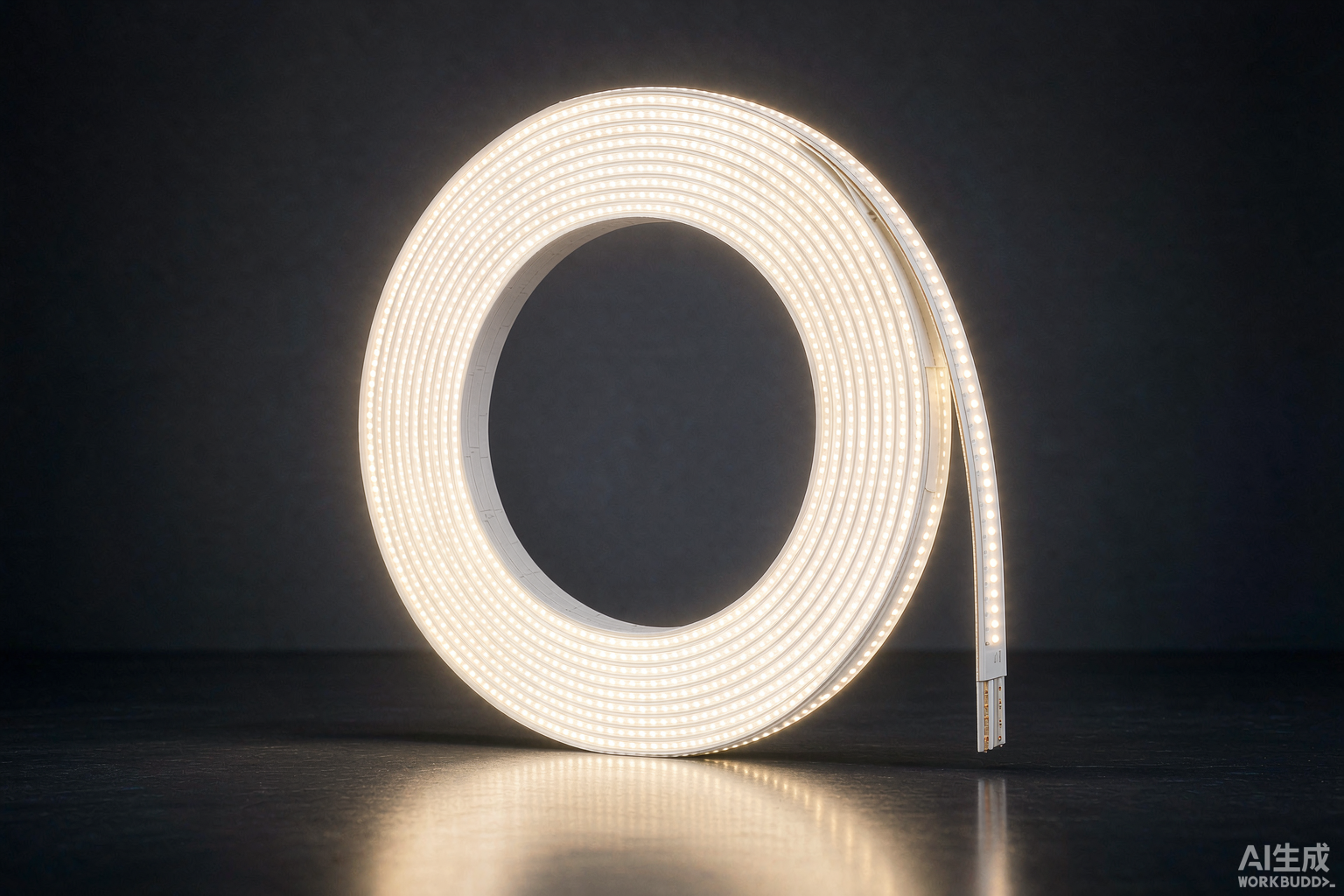
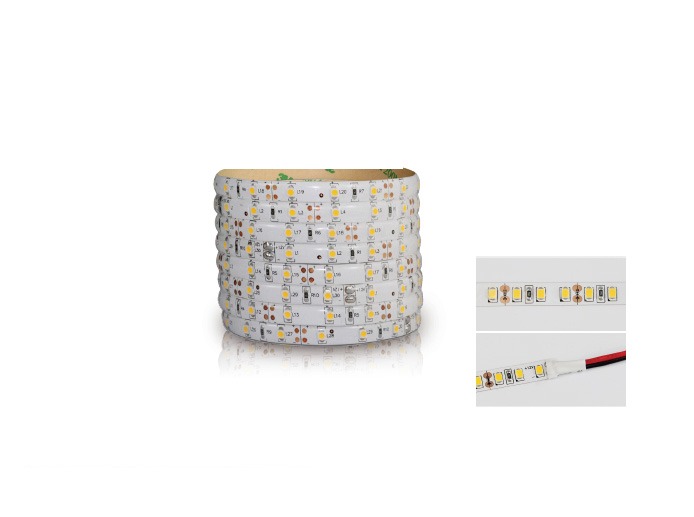
How many packages sit in 1 m. SMD 60-120 per metre is a general wash; 320-480 COB is a dot-free line for close viewing.
Dot-free / COB
Chip-on-Board puts the die directly on the PCB with a phosphor dome instead of individual packages, so no dot is visible from the intended viewing distance.
Cutting pitch / scissor mark
The distance between legal cut points. DC24V strips cut every 25 mm (or 8 LEDs); DC12V every 25 mm (or 6 LEDs). Cutting away from the mark breaks a supply trace.
Virtual junction
A mid-reel power injection point. Requires cutting at the mark and adding a two-pin jumper plus a power feed — not relying on the connector to carry power.
Voltage drop
Loss along the conductor. Causes the far end to dim and shift colour. Controlled by feed distance, cable cross-section and 24V instead of 12V.
Bin / binning
The sorting of LEDs by brightness and colour. Matching brightness and colour across a project means matching bins, which means one production batch.
SDCM / 3-step MacAdam
How tightly bins are grouped. Lower (1-3 step) means less visible colour difference between reels — relevant from about 10 m of line upwards.
PCB width / board width
8 mm or 10 mm standard; 5 mm for tight reveals and cabinets. It decides whether the strip physically fits the channel you have.
Tape / 3M adhesive
The backing on the strip. It holds, but it is not a thermal path and it fails on dusty or uneven surfaces — clip it mechanically for anything permanent.
Aluminium channel / heat sink
Extruded profile the strip mounts into. Carries heat away, hides the board, and lets you add an opal diffuser. Standard practice above 10 W/m.
PWM / frequency
Pulse-width modulation dimming. Below roughly 1 kHz the modulation is visible as flicker on camera and to some eyes — ask for the dimming frequency spec.
DMX512 / addressable / SPI
DMX512 is the theatrical standard with one address per controller channel; SPI (WS2812/SK6812) addresses each pixel. Addressable strips need a data line in addition to power.
Constant voltage (CV) vs constant current (CC)
Almost all strips are CV (12/24V). Drivers are CV. Mixing a CC driver with a CV strip is a failure, not an adaptation.
Warranty and L70
Warranty is usually 2-3 years. L70 (time to 70% of initial luminance) is the lifetime metric used with TM-21 projections — ask for both.